Anchor customers
Shape X1 around a priority application — secure communications, Earth intelligence or situational awareness — and receive early access to its validated data products.

English · aiqsat.com
AIQSAT · Main mission
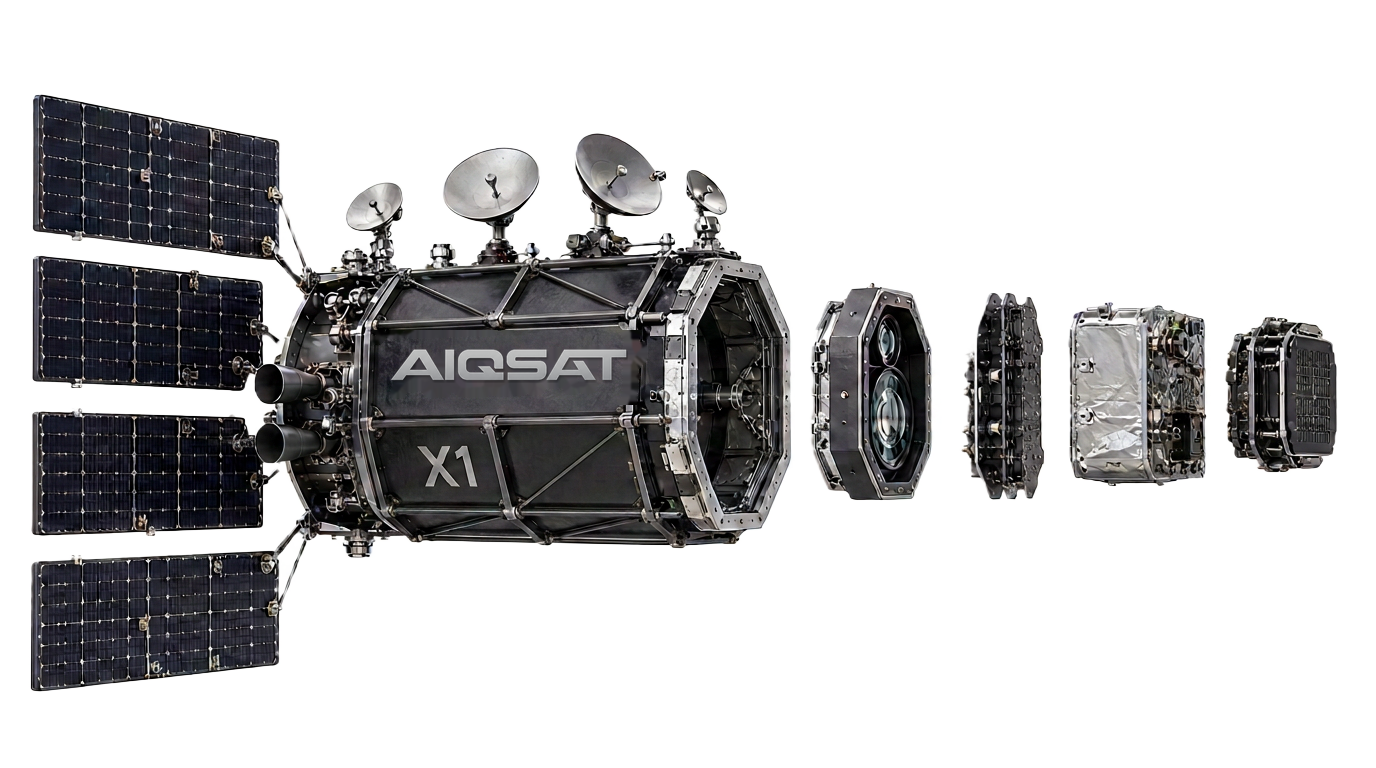
The first integrated AIQSAT spacecraft — a pathfinder for intelligent, quantum-secure orbital data exchange.
The flagship development project of AIQSAT — a single pathfinder spacecraft that proves onboard AI, quantum-secure communication and a modular platform can operate as one resilient system in orbit.
Interactive · X1 assemblies
Select a marker on the spacecraft to read what that assembly does.
AI-07
The AIQSAT CORE X1 compute module runs inference directly in orbit: it filters raw sensor data, prioritises what matters and turns observations into decisions before anything is sent down.
Mission X1
X1 is the flagship development project of AIQSAT: a single pathfinder satellite that combines onboard artificial intelligence, quantum-secure communication links and a modular mission platform. Its purpose is to prove, in orbit, that the three capabilities behind AIQSAT — AI, Quantum and Satellite — can operate as one resilient system that exchanges data more efficiently and more securely than today.
Compressed AI models run directly on X1, interpreting sensor data and prioritising only valuable information for downlink.
An optical quantum key distribution terminal exchanges tamper-evident keys between the spacecraft and a ground station.
A reusable bus sized for AI compute and sensitive optics, designed to evolve into a constellation rather than a one-off.
Payload, AI, secure communications and automated ground operations are validated as one end-to-end system on a single flight.
Why X1 matters
X1 is not a technology demonstrator in isolation. It is the first time AIQSAT unifies its three fields — Artificial Intelligence, Quantum and Satellite — into one operating system in space. Every later mission, partnership and service can build on what X1 proves: that intelligent, quantum-secure orbital data exchange is not a collection of capabilities, but a single, trustworthy network.
Beyond X1 — the orbital hub
X1 is the first step. Once its integrated architecture is proven in orbit, AIQSAT evolves toward a larger vision: an orbital AI Quantum computing center that acts as a central node for every AIQSAT satellite — processing, routing and securing data across an entire constellation.
What the visualisation shows
The animation above is our concept visualisation of the orbital AI Quantum data center — a slow drift around the station as it would appear on station, in a high orbit above Earth. Every element in the scene stands for a part of the architecture we are working toward.
The long truss with pressurised and unpressurised modules houses the compute core: radiation-tolerant AI accelerators, cryogenically cooled quantum hardware and the thermal systems needed to keep both stable in vacuum.
Large deployable arrays track the sun because orbital compute is power-limited before it is anything else. Their scale in the visualisation reflects how much energy a permanent data center in orbit has to harvest and store.
The thin optical links represent the quantum-secure mesh: laser inter-satellite terminals carrying data and distributing tamper-evident keys between the hub, its satellites and the ground segment.
The smaller spacecraft around the station are the X-series missions — X1, X2 and those that follow — connected as lightweight sensing nodes that offload heavy processing to the hub.
The slow rotation and gentle camera drift show the station in a stable, continuously operating orbit; the deep-space backdrop marks it as free-flying infrastructure rather than a ground facility.
The visualisation is a design study to communicate the architecture and scale of our vision. Module layout, orbit and hardware will evolve with what Mission X1 proves in flight.
The hub receives, aggregates and processes data from every connected satellite, so individual spacecraft can stay light while compute-heavy workloads run on the station.
Radiation-tolerant AI accelerators and quantum-secured processing modules run inference, scheduling and key management directly in orbit, reducing latency and ground dependency.
Optical inter-satellite links distribute tamper-evident keys across the network, so data moving between satellites and the hub stays protected end-to-end.
As X1 proves the modules, X2 and the missions that follow plug into the same hub — turning a single spacecraft into a growing, reusable orbital infrastructure.
Mission sequence
Fly a single spacecraft that validates onboard AI, quantum-secure links and automated delivery as one trustworthy system in orbit.
Add a second mission that establishes inter-satellite links and routes data toward the central hub, proving the network concept.
Deploy the hub station as the central compute and key-distribution node for the constellation, hosting heavier workloads and coordinating the fleet.
Grow the network with further missions that share the hub, creating a resilient, quantum-secure orbital data infrastructure.
The opportunity
Most satellites today are built for one job: they collect data, wait for a ground pass and send everything to Earth, where a separate system decides what it means. That cycle delays decisions, wastes limited bandwidth and leaves security dependent on cryptography that future quantum computers may undermine. No single mission has yet shown AI inference, quantum-secure communication and an automated ground chain working together as one trustworthy system.
With X1, AIQSAT is building the first integrated demonstration of its complete architecture. X1 is a pathfinder spacecraft designed to prove that an intelligent satellite can interpret its own data, protect the link back to Earth with quantum technology and deliver decision-ready information through an automated chain — the foundation for a future constellation.
System architecture
The project is designed as a modular system. Each layer can create value independently, while the complete architecture enables a secure, intelligent data network across orbit and Earth.
Earth-observation and platform sensors feed an onboard AI layer that masks clouds, detects events and attaches confidence before anything is transmitted.
Mission logic selects which observations and alerts are worth bandwidth, schedules follow-up tasking and manages power around compute bursts.
An optical quantum key distribution terminal establishes tamper-evident keys with the ground, combined with post-quantum cryptography for every pass without a link.
An automated ground segment receives prioritised products, monitors telemetry and hands decision-ready information into customer systems through secure interfaces.
Strategic value
AIQSAT is being shaped for organisations that need resilient infrastructure, faster access to useful information and a security model designed for the quantum era.
Shape X1 around a priority application — secure communications, Earth intelligence or situational awareness — and receive early access to its validated data products.
Qualify optical terminals, AI accelerators, photon sources or sensors on a real integrated mission with defined interfaces rather than an isolated experiment.
Evaluate a path toward a resilient, low-touch constellation that can serve multiple missions from a common foundation.
Back the proof point that de-risks the wider AIQSAT platform and creates reusable intellectual property for every mission that follows.
Development path
The roadmap is structured to retire technical risk early, prove interoperability and create clear decision points for partners and capital providers.
Design
Define the X1 orbit, payload mix, power and pointing budget, and the success criteria that prove the integrated operating concept.
Engineering
Validate spacecraft, AI compute, quantum terminal and ground operations together in simulation and a flight-like engineering model.
Flight
Fly the pathfinder and demonstrate onboard inference, quantum-secure key exchange and automated delivery under real orbital conditions.
Scale
Use lessons and qualified modules from X1 to standardise a repeatable spacecraft — X2 and the missions that follow connect into the orbital hub and grow into a network of intelligent satellites.
Investment case
The project combines differentiated engineering, reusable intellectual property and a platform approach intended to support multiple missions, customers and commercial models.
X1 retires technical risk across AI, quantum and satellite in a single flight, creating the evidence that supports every later mission.
The onboard software, secure link design and ground automation developed for X1 are intended to transfer to subsequent spacecraft without rebuilding.
A successful pathfinder opens recurring value through hosted payloads, data products, secure capacity and constellation operations.
Build the next layer with us
We are seeking an anchor use case, payload partners and strategic capital to bring X1 from design to flight — the first concrete step toward an intelligent, quantum-secure orbital data network.
Next steps
Shape X1 around a priority application and gain early access to its validated data products.
Qualify your payload, terminal or sensor on a real integrated mission with defined interfaces.
See where intelligent, quantum-secure orbital data creates an advantage for your sector.